Captain Mode: Adventure Is Fun Until Somebody Has to Be in Charge
We thought living on a boat would mean freedom, sunsets, weird stories, and the kind of adventures that make everybody back home say, “Wow. Good for you.”
And it did.
But that’s only half the truth.
Because adventure is fun right up until somebody has to be in charge.
Somebody has to hear the weather differently.
Somebody has to notice the radio tone change.
Somebody has to check the lines, think through failure, and stay steady while everything around them gets loud.
That is the part nobody romanticizes.
But that is also the part where the dream gets real.
This is Episode 6 of Life Afloat: The Boat Season, our chronological series about the 18-month chapter where Matt & Linda lived on a classic motor yacht in Florida and learned a few things the adventurous way.
The Forecast Said Thunderstorm
The forecast said thunderstorm.
Cool.
That’s Florida.
If you live there long enough, you stop flinching at thunder. You close a hatch, grab a snack, and keep living.
So when people later asked if I was worried, I said no.
Which was technically true.
Because at the beginning, I did not yet know what I should be worried about.
Later, we found out it was not just a thunderstorm. It was the “No Name Low” that hit the Keys in mid-November. Wind gusts got wild. Power went out. Flooding happened. People who normally sounded calm stopped sounding calm.
But on that day?
I thought it was just weather.
NOT.
Living on a Mooring Ball Sounds Cute Until It Matters
The day before, I had driven Linda down to Key West airport.
That’s about an hour and a half each way, and we always liked that drive because it gave us an excuse to stop at the Navy base for supplies and whatever else Marathon charges you a kidney for.
Then I dropped her off.
And drove back to Boot Key Harbor.
Alone.
No big deal.
I had projects to do because boats are basically floating lists of unfinished projects. That day’s project was the dinghy motor, which ran, but not well. A fun little wrinkle, since the dinghy is your car when you live on a boat.
If you have never lived on a boat, let me translate something.
In Boot Key Harbor, most boats are “on a ball.”
That means you tie your boat to a mooring buoy permanently anchored to the bottom.
It’s not your anchor.
It’s the harbor’s system.
It’s designed for this.
It’s supposed to be safer.
Supposed to.
Because the ball is only as safe as:
- the lines you use
- the way you tie up
- and whether the system decides to have a mood
And that evening?
It had a mood.
We knew weather was coming, so I spent the day battening down the hatches, which is a real boating phrase and not just pirate cosplay. It basically means: close everything before water enters your floating house and ruins your last shred of confidence.
Rain is annoying.
Wind is personal.
One of the benefits of being on a ball is that your boat naturally turns to face the wind. That’s what you want. Head-on is fine. Sideways is where things get ugly.
And once the wind came, Slow Ride did exactly what she was supposed to do.
She turned.
And then turned again.
And again.
That’s when I knew this was not normal anymore.
The Harbor Got Loud
This part was actually kind of beautiful.
In a mildly terrifying way.
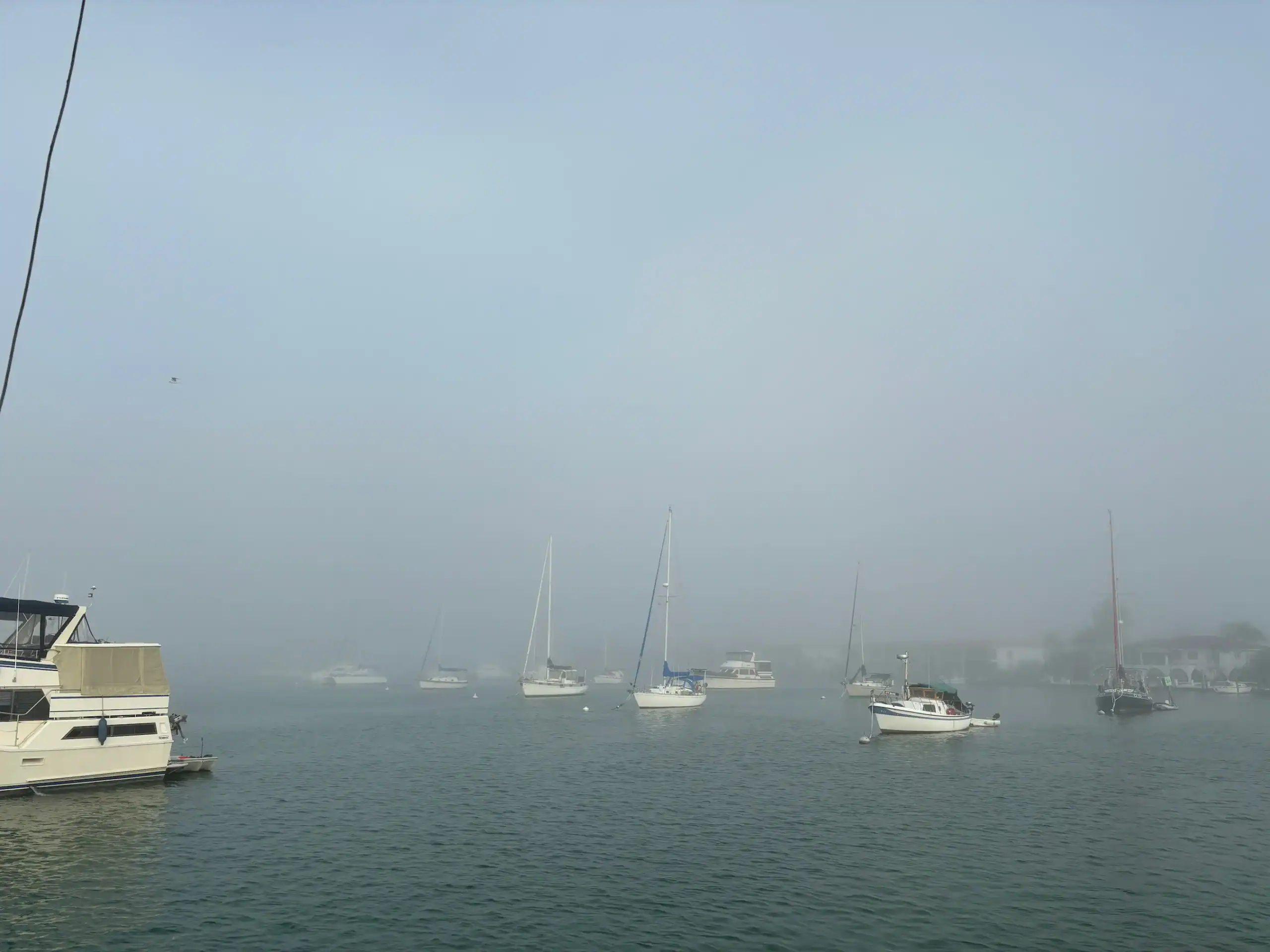
When you look out across Boot Key Harbor in strong wind, you can see all the boats doing this synchronized dance. A whole harbor of floating homes slowly rotating around their mooring balls together.
Tiny wind shift.
Hundreds of boats turn.
Everything moves in unison.
It’s peaceful.
Until it’s not.
Because then the radio got loud.
And that’s when I knew we were not dealing with a normal storm anymore.
These weren’t rookies on the radio. Some of those captains had been coming to that harbor for forty or fifty years. They had seen everything.
And they did not sound calm.
They started barking instructions like a marina version of air traffic control.
Add another line.
Check your cleats.
Secure your dinghy.
Take your bimini down before it turns into a kite.
Then the call came through.
A boat had broken loose and was heading toward another boat.
They needed help.
That’s when the whole thing stopped being weather and started being responsibility.
Not My Dinghy
In theory, helping is simple.
You get in your dinghy.
You go out in the wind and rain.
You throw a line on the loose boat.
You help pull it away before it becomes a floating car wreck.
In reality, it takes an armada.
And here is what I contributed to the armada:
Nothing.
Because my dinghy motor was already struggling in good weather. There was no version of that little engine that was about to save the harbor in a storm.
So I did what I could do.
I went outside and checked if the loose boat was heading toward me.
Then I went back inside and listened to the radio like it was the only thing holding my sanity together.
Because now my brain was doing math.
What if my mooring fails?
What if my lines chafe through?
What if one of the derelict boats nearby comes loose?
What if something hits us in the dark?
What if I missed something?
That’s the part nobody tells you about adventure.
Sometimes the biggest pressure is not action.
It’s awareness.
It’s holding all the possible failure points in your head at once and trying not to let your imagination turn into panic.
What?! I’m the Captain?!?
There were abandoned boats around me.
Boats nobody had cared for in a long time.
And I had no idea what shape their lines were in.
So I went into full captain mode.
Which felt ridiculous, because…
I’m not a captain.
Except apparently, I was.
What?! I’m the captain?!?
I kept one eye on my lines.
The other eye on the harbor.
All night.
I scanned.
I listened.
I got up more times than I can count.
Not because I was brave.
Because I was responsible for the floating condo I loved.
And because Linda wasn’t there.
And because sometimes the quiet power move is not panic.
It’s staying steady when everything around you is loud.
That may be the real definition of Captain Mode.
Not swagger.
Not authority.
Not yelling nautical words into the wind.
Just responsibility under pressure.
The Quiet Weight of Responsibility
This is where the episode stops being about boats.
Because Captain Mode is not really a boating thing.
It’s a grown-up thing.
It’s the moment you realize the freedom you wanted still comes with systems, structure, and somebody having to carry the mental load.
Somebody has to notice.
Somebody has to prepare.
Somebody has to stay steady.
Somebody has to think farther ahead than everybody else in the room.
That is true on a boat.
It is also true at work, at home, in marriage, in parenting, and in every part of life where somebody has to carry the weight of responsibility.
And here’s the thing about that weight:
You do not really understand it until it’s yours.
Your boss isn’t just your boss.
Your parents weren’t just your parents.
Your spouse isn’t just your spouse.
They are people carrying a load that is specific to the responsibility they hold.
The decisions.
The pressure.
The what-ifs.
The quiet math.
The need to stay steady while other people get to react.
That load is hard to explain from the outside.
You only really feel it when you’re the one lying awake listening to the wind, checking the lines, or trying to hold things together while everybody else assumes it will probably be fine.
That realization did something to me.
It made me see responsibility differently.
It also made me think maybe we should all give each other a little more grace.
Give your boss some grace.
Give your parents some grace.
Give your spouse some grace.
And while you’re at it, receive some too.
Because sometimes, when the whole thing gets loud and the weather turns and the shit hits the fan, grace is the only thing you can hold onto until morning.
People love the language of freedom.
They like far less the language of responsibility.
But the truth is, one without the other usually turns into chaos.
The dream does not stop being worth it because it comes with weight.
It just becomes real.
Morning: Still Floating. Still Here.
By daylight, it was still windy and rainy, but nothing like the night before.
The boat was still floating.
The dinghy was still there.
The lines had held like they were supposed to.
Which I would like to credit to my excellent line-tying skills.
Hell yeah. I’m doing this.
The harbor shifted into recovery mode.
People started checking on each other.
Dinghies went out.
Voices called across the water.
“You okay?”
“You good?”
“Anybody lose anything important?”
Our damage report was pretty light.
We didn’t lose the bimini, but it had ripped along the front edge where the wind hits hardest.
Other than that?
We made it.
And something changed in me that night.
It did not just scare me.
It marked me.
Before that, we were people who had bought a boat.
After that, we were people who lived on one.
After that night, I was not just the guy enjoying the adventure.
I was the guy who knew he could hold the line.
Not perfectly.
Not heroically.
But steadily.
And that’s the kind of tenacity nobody posts about.
The quiet kind.
The kind that holds.
Life Design Takeaway: Freedom Still Requires Leadership
If you want a different life, a more intentional life, a freer life, there will come a moment when somebody has to be in charge.
Maybe that’s you.
Actually, if it’s your life, it probably is.
That does not mean you need to become controlling or joyless or obsessed with checklists for the thrill of office supplies.
It means you have to become the kind of person who can enjoy the dream and still carry the weight of it.
Because intentional living is not just choosing what you want.
It is also choosing what you are willing to steward.
That means systems.
That means preparation.
That means responsibility.
That means leadership, even when no one hands you a title.
So if the life you want feels heavier than expected, that does not necessarily mean you chose wrong.
It may mean you have crossed into the part where freedom stops being fantasy and starts becoming something you can actually hold.
Adventure is fun until somebody has to be in charge.
And then, if you stay with it, that somebody becomes you.
To be continued…
With love and laughter,
Matt & Linda
No 2 The Quo
This is part of Life Afloat: The Boat Season, our chronological series about the 18-month chapter where Matt & Linda lived on a classic motor yacht in Florida and learned a few things the adventurous way.
→ Next up: Marriage in a Floating Condo: What Close Quarters Reveal
→ Start at the beginning: Life Afloat: The Boat Season
If you want the framework underneath all of this, start with the Declaration of Intendependence™. It’s the process behind the chaos: choose on purpose, take action, and stay tenacious until the thing you keep talking about becomes your actual life.
Before We Had the Framework, We Had the Stories
We didn’t start No 2 The Quo with a tidy little life design model and a color-coded spreadsheet.
Shocking, I know.
We started with a few lived decisions. Big ones. Messy ones. The kind where you say, “This is probably fine,” while quietly wondering if you have lost your entire mind.
These three stories explain how we got here before we had the words Declaration of Intendependence™ to describe what we were doing.
These are the origin stories behind No 2 The Quo.
👉 Why We Said No 2 The Quo After the Kids Left Home
👉 It Took Two Years to “Suddenly” Change Our Lives
👉 Yes, We Really Did Pack Our Whole Life Into a Car and Leave
Ready to Start Redesigning Your Life?
Download our free guide:
“How to Start Redesigning Your Life This Week (Even If You Think It’s Too Late)”
Get the 3-step framework we used to go from burned out to full-time freedom.
No theory. No fluff. Just practical moves you can make this week.
Plus, you’ll get our weekly emails every Tuesday—Life Design strategies and adventure stories that prove freedom is possible.
No spam. No nonsense. And yes, we’ll probably talk about helmets.